
Seborrheic dermatitis is a chronic inflammatory dermatosis that commonly affects oil-rich areas of the face, including the delicate eyelids.The skin around the eyes is thin, sensitive, and highly visible. Even mild inflammation can look dramatic and feel frightening.
Eyelid flares can appear red, flaky, swollen, or greasy. Some people experience itching. Others describe burning or tightness. Makeup may suddenly sting. Skincare that once worked becomes irritating.
This does not mean your skin is broken.
It means the eyelid barrier is inflamed.
And once you understand why it happens, it becomes manageable.
If you want a full overview of seborrheic dermatitis across the scalp and face, see our complete seborrheic dermatitis guide:
Why the eyelids flare so easily
The eyelids contain tiny oil glands along the lash margins called meibomian glands. These glands lubricate the eye surface and protect vision. However, they also create a micro-environment where inflammation can develop.
Seborrheic dermatitis is linked to an immune overreaction to a yeast called Malassezia. This yeast lives naturally on everyone’s skin. It is not an infection. It is not contagious. It is part of normal skin biology.
The problem is immune sensitivity.
In people prone to seborrheic dermatitis:
- inflammation increases
- skin turnover accelerates
- flakes build up
- redness appears
- the barrier weakens
Because eyelid skin is extremely thin — about four times thinner than cheek skin — even small inflammation becomes highly visible.
Add rubbing, crying, makeup removal, winter dryness, allergies, or fatigue, and the cycle intensifies.
This explains why eyelids can flare suddenly and dramatically.
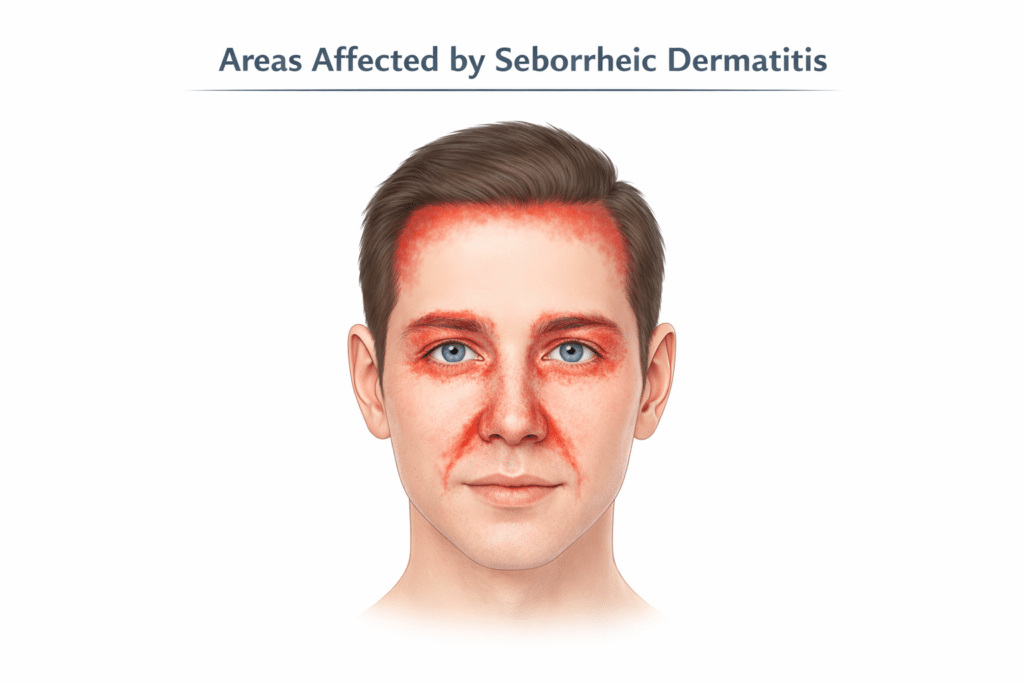
Seborrheic dermatitis tends to repeat in oil-rich areas of the face, which is why eyelids, nose folds, eyebrows, and scalp are frequent flare zones.
How eyelid seborrheic dermatitis differs from allergies
| Allergic Reaction | Seborrheic Dermatitis | |
|---|---|---|
| Onset | Sudden | Gradual, recurring |
| Pattern | Trigger-based | Cyclical |
| Itch level | Often intense | Mild to moderate |
| Duration | Short-term | Chronic tendency |
| Location | Can vary | Repeats in same areas |
| Trigger | Specific allergen | Yeast + inflammation |
| Response | Antihistamines help | Antifungal care helps |
| Skin appearance | Hives / rash | Flaking + redness |
Many people confuse seborrheic dermatitis with allergic reactions.
Understanding this difference prevents panic and unnecessary product switching.
Not sure if this is seborrheic dermatitis or eyelid eczema? Visit our complete Eczema Hub for symptoms, triggers, and gentle routines.
Consistency matters more than chasing quick fixes.
Common eyelid symptoms
Symptom | What it feels like | Why it happens — | — | — Redness | Visible irritation | Surface inflammation Flaking | Powdery skin | Accelerated turnover Greasy scaling | Lash buildup | Yeast activity + oil Burning | Stinging sensation | Barrier breakdown Puffiness | Swollen lids | Local immune response Cosmetic sensitivity | Makeup stings | Inflamed nerve endings
Symptoms may affect:
- upper eyelids
- lower eyelids
- lash margins
- outer eye corners
- skin beneath brows
Typical signs include:
- redness around the eyelids
- flaky or powdery scaling
- greasy lash buildup
- itching or stinging
- puffiness
- burning when applying skincare
- watery or irritated eyes
- cosmetic sensitivity
- scaling that reappears after washing
Unlike simple dryness, seborrheic dermatitis rarely disappears with moisturiser alone.
Inflammation must also be controlled.
For more please see our full seborrheic dermatitis symptom guide.
What makes eyelid flares worse
Trigger | Effect on eyelids — | — Fragrance | Barrier irritation Rubbing eyes | Mechanical damage Harsh cleansers | Oil stripping Stress | Immune activation Winter air | Severe dryness Over-washing | Barrier collapse Heavy cosmetics | Occlusion + irritation Essential oils | Chemical sensitivity
The eyelid barrier is fragile. Small irritations escalate quickly.
Common aggravators include:
- fragranced eye creams
- harsh makeup removers
- rubbing the eyes
- essential oils
- alcohol toners
- stress
- illness
- winter air
- indoor heating
- over-cleansing
- heavy cosmetics
- lash adhesives
- aggressive exfoliation
Many people worsen symptoms by repeatedly changing products.
Constant switching destabilises the barrier.
Gentle consistency works better than aggressive experimentation.
A simple eyelid routine that actually helps
| Time | Step | What to Do |
|---|---|---|
| Morning | Cleanse | Rinse with lukewarm water or a gentle cleanser |
| Dry | Pat dry — do not rub | |
| Moisturise | Apply a soothing fragrance-free moisturiser | |
| Protect | Use mineral sunscreen around the eyes | |
| Evening | Cleanse | Cleanse gently |
| Remove makeup | Remove makeup carefully without scrubbing | |
| Moisturise | Apply moisturiser immediately | |
| Simplify | Keep routine minimal |
Short routines protect the barrier and calm inflammation.
| Avoid | Why |
|---|---|
| Scrubs | Damages fragile eyelid skin |
| Acids | Increases irritation |
| Retinoids near eyelids | Too strong for thin skin |
| Essential oils | Common irritation trigger |
| Fragranced creams | Weakens the skin barrier |
Barrier support is the priority.
Calm skin heals faster.
A soothing barrier cream is often the most important step in an eyelid routine. The goal is not to overload the skin, but to calm inflammation and reinforce the protective barrier. Gentle formulations that focus on hydration and repair — rather than active exfoliation — tend to perform best on eyelid skin. Many people find that a snail mucin–based barrier cream such as Bragan Skincare Atopic Cream helps reduce irritation while keeping the area comfortably moisturised. Products like this are not a cure, but they can support stability when used consistently alongside medical care.
How antifungal treatment fits in
Eyelids require caution.
Stronger antifungal washes are not used daily near the eyes.
During active flares, dermatologists may recommend:
- ketoconazole cream
- zinc-based treatments
- short courses of mild anti-inflammatories
These treatments should be used under professional guidance when close to the eye.
Never apply aggressive treatments without advice.
Gentle supervision is safer.
Long-term maintenance mindset
Seborrheic dermatitis is chronic.
It behaves in cycles.
The goal is control, not cure.
Maintenance focuses on:
- gentle daily cleansing
- consistent moisturising
- stress awareness
- early flare treatment
- avoiding irritants
- barrier protection
Many people achieve long symptom-free periods once they recognise their triggers.
This is a management condition.
Not a personal failure.
Long-term control depends heavily on barrier support. When the eyelid skin stays hydrated and protected, flare intensity usually drops. A simple moisturising step repeated daily is more effective than complicated treatment layering. Barrier-first creams — especially fragrance-free, repair-focused options — help create a stable environment where inflammation is less likely to escalate.
Seasonal eyelid care
Winter often worsens eyelid inflammation because:
- air becomes dry
- heating strips humidity
- illness increases immune stress
Winter adjustments:
- moisturise more frequently
- avoid hot water washing
- protect skin outdoors
- consider humidifiers
Summer can also trigger flares through:
- sweating
- sunscreen sensitivity
- oil buildup
Lightweight formulas work better in warm weather.
Routine should adapt to climate.
Emotional impact of eyelid flares
Eye-area skin conditions affect confidence more than people admit.
Redness near the eyes is impossible to hide. It can feel embarrassing. Many people withdraw socially during flares or avoid eye contact.
It is important to understand:
- this condition is common
- it is not contagious
- it is manageable
- it does not reflect hygiene
- it improves with knowledge
Control comes from understanding patterns.
Not fighting your skin.
Similar flares can appear beside the nose and scalp. See how facial seborrheic dermatitis behaves across areas.
Mistakes that prolong eyelid inflammation
| Mistake | Why it’s harmful |
|---|---|
| Scrubbing flakes away | Damages fragile eyelid skin |
| Acne treatments near eyes | Too harsh for thin eyelid tissue |
| Constant product switching | Prevents barrier recovery |
| Over-cleansing | Strips protective oils |
| Layering active ingredients | Triggers inflammation |
| Trying to “dry out” skin | Worsens irritation cycle |
| Repeated steroid use unsupervised | Risk of thinning skin |
| Essential oils | High irritation risk |
Seborrheic dermatitis is not dirt.
It is inflammation.
Calming works better than attacking.
Recovery timeline and expectations
| Timeframe | What improves |
|---|---|
| Week 1 | Itching decreases |
| Week 2 | Redness softens |
| Weeks 3–4 | Flaking reduces |
| Week 6 | Stability increases |
| Maintenance | Longer flare gaps |
Many people expect overnight results. That leads to frustration.
Realistic improvement looks like:
- 1 week → itching reduces
- 2 weeks → redness softens
- 3–4 weeks → visible calming
- 6 weeks → stabilisation
Consistency matters more than intensity.
Relapses are normal.
Early response prevents escalation.
When to seek medical advice
Professional care is important if:
- eyelids swell significantly
- vision is affected
- infection appears
- skin cracks or bleeds
- symptoms spread
- over-the-counter care fails
- flares are frequent or severe
Dermatologists can safely treat eyelid inflammation.
There is no weakness in seeking help.
It is part of correct management.
For trusted clinical reading, see the HSE website.
Prevention mindset
Long-term success comes from:
- recognising early signs
- treating gently and early
- maintaining routine
- avoiding panic changes
- protecting the barrier
- accepting the cycle
Seborrheic dermatitis behaves predictably once understood.
The goal is stability, not perfection.
For full condition guidance, see our comprehensive guide.
Frequently asked questions
Is eyelid seborrheic dermatitis dangerous?
No. It is uncomfortable but manageable with correct care.
Can it damage my eyes?
Not typically, but severe inflammation should be reviewed by a doctor.
Is it the same as blepharitis?
They overlap. Many eyelid cases share features with seborrheic blepharitis.
Can makeup cause it?
Makeup doesn’t cause it, but fragranced or heavy products can worsen flares.
Should I exfoliate eyelids?
No. Eyelid skin is too thin for exfoliation.
Does stress trigger eyelid flares?
Yes. Stress strongly correlates with activity.
Will it go away permanently?
It tends to cycle, but many people achieve long clear periods.
For full condition guidance, see our complete seborrheic dermatitis hub.